Building Finance OS: The case for AI-agent-native personal finance
Izzat · Tuesday, April 14, 2026
Every month I do the same ritual. Open my banking app, scroll through transactions. Open my second banking app, scroll through more transactions. Open my trading app, download the statement. Add each transaction to my expense tracker one by one. Check if the balance matches. If it does not, dig through everything to find what I missed. Try to remember what that ATM withdrawal in February was for. Spend three hours doing this, feel vaguely enlightened for 24 hours, and then forget all of it until next month.
This is the monthly finance recap. It is not difficult. It is just tedious. And I have been tolerating it for years.
Why Money Lover stopped being enough
I have been using Money Lover for a long time. It was the right tool for 2018: simple wallet-based tracking, CSV import from a few banks, basic charts. It did not require much setup and it got the job done well enough.
But "well enough" has a cost that compounds over time. Money Lover is manual by design. Every transaction needs to be categorized. Every import needs to be matched against the previous month. Every month needs to be reviewed in a separate session that you have to schedule and actually commit to. None of this is automated. None of it can be delegated to the AI assistant I already use for everything else.
The moment I started using AI agents seriously (Claude Code, then Hermes Agent), I kept noticing the same gap: I had an agent that could write code, run research, manage my inbox, and handle a dozen other workflows, but it could not tell me how much I spent on groceries last month. That felt like a solvable problem.
What I actually want from a finance tool
The monthly recap is not complicated. It is a series of questions:
- How much did I earn and from where?
- How much did I spend and on what?
- Are my wallet balances correct?
- Did anything unusual happen: a refund, a duplicate charge, a currency mismatch?
Answering these manually takes hours because the data is fragmented across six apps and none of them talk to each other. An AI agent could answer all of them in seconds, if it had access to the data.
That is the problem Finance OS is built to solve. Not a new UI for entering transactions. Not another app to check every day. An open finance layer that any AI agent can plug into and answer those questions reliably.
I believe the future of software is agentic. We are not the only users of the tools we build; our agents will use them too. This is not entirely new. Bots and automation have always existed on the web, but we spent years blocking them, building CAPTCHAs, and treating programmatic access as adversarial. Now we need the opposite: proper paths for agents to use the tools we use daily. That is the mindset behind Finance OS. This tool is built for us and our AI agents.
The design decisions that follow from the use case
Once you design for AI agents first, the architecture choices become clearer.
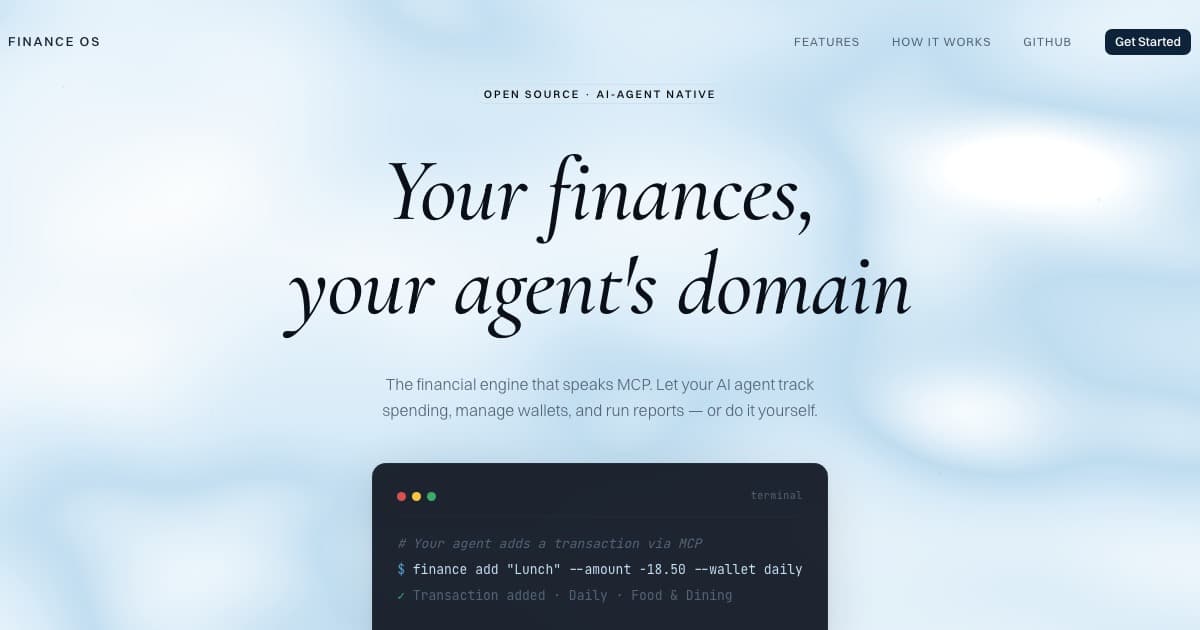
CLI and MCP come before the dashboard. Most finance apps start with a mobile app and maybe a web dashboard. Finance OS starts with a REST API, a CLI, and an MCP server. The dashboard exists because humans still want to look at charts, but the agent interface is the primary surface.
Standard data format wins over custom logic. Transaction data should be importable from anything. Current support includes Money Lover CSV, Trade Republic PDF statements, and a generic format. The goal is not to support every bank natively. It is to make importing from any source a solved problem that any agent can automate.
Wallets, not accounts. The mental model is wallet-based: you have a Jenius account, a Wise balance, a Trade Republic portfolio, a cash envelope. The system tracks what goes in and out of each, reconciles them against real transaction data, and can answer questions about any of them on request.
Self-hostable by design. This is open source under AGPL-3.0. Anyone can run it locally with Docker. You own your data, you run your own instance, and you control which agent can access it. There is no dependency on my infrastructure for the core product to work.
What the agent workflow actually looks like today
With the MCP server configured, an agent can do things like:
finance_balance          → total by currency + per-wallet breakdown
finance_search Trains    → all train transactions with totals
finance_monthly_report   → income, expenses, transfers, fees for a month
finance_reconcile        → flag discrepancies between wallets and real transactions
The agent knows my finance data the same way it knows my codebase or my calendar. I can ask it questions like "what were my biggest expense categories in February?" or "did any wallet go negative this month?" and get an actual answer instead of "open the app and check."
This is exactly why I built Finance OS this way. I can give my agent a raw PDF bank statement and ask it to input the transactions. The agent is smart enough to read the document, extract the line items, and translate them into the format Finance OS expects. No custom parser needed for each bank. The agent is the parser.
It goes beyond querying too. I have a target net worth goal in mind. I can ask my agent to analyze my current trajectory, tell me if it is realistic, and suggest what I should adjust. The agent has the full picture: income patterns, spending habits, existing assets. It can give me an actual plan instead of a generic "save more money" recommendation.
I use Hermes Agent for this. Because Hermes also knows my context (what I am working on, what I care about, what my plans are), it can shape the response to be more personalized. It is not just a finance tool answering finance questions. It is my agent, with memory of me, using my finance data to give advice that actually fits my situation.
Why open source matters here
The point of making Finance OS open and agent-native is this: I want any person using any AI agent — Claude Code, Codex, OpenClaw, Hermes, whatever comes next — to be able to point it at their finance data and start asking questions.
The agent ecosystem is growing fast. More people are delegating work to AI agents. But most agent workflows still have a gap where personal finance sits: too sensitive to put in a third-party API, too tedious to manage manually, too useful to ignore. A standard, open MCP interface for finance data closes that gap for the whole ecosystem, not just for my setup.
This is Bring Your Own Agent (BYOA). You pick the agent. You own the data. Finance OS is just the layer that makes your financial data accessible to whatever AI you trust. Whether you self-host or use a hosted version in the future, the core stays open.
What comes next
Finance OS is now public on GitHub. The core engine works: wallet tracking, transaction management, multi-currency analytics, CLI, REST API, and MCP integration for AI agents. I use it for my own monthly recaps, and the agent-as-parser workflow has replaced hours of manual spreadsheet work.
What I am building next:
- More MCP tools. Budgeting, spending goals, cash flow forecasting. The more questions an agent can answer, the more useful the system becomes.
- Better dashboard visualizations. The agent interface is primary, but humans still want to see charts. The current dashboard is functional. I want it to be good.
- A hosted version. Self-hosting is great for tinkerers, but not everyone wants to run Docker. A hosted option would make Finance OS accessible to people who just want to point their agent at their finances and go.
If this resonates with how you use (or avoid) your own finance apps, the repo is at github.com/izzatr/finance-os. You can spin it up locally with Docker Compose, inspect the API, use the CLI, or wire it into an MCP-compatible agent and start asking questions against your own data.
The goal is simple: stop spending hours doing a job that a machine should do. Build the finance layer that makes that possible for anyone running an AI agent.